May 14, 2010

Naya Daur, Purani Baten

Film goers at Mumbai's Maratha Mandir on Aug. 5, 1960, came out quite confused. It wasn't clear why various characters in the newly released movie kept calling out for pillows at the end of profound conversations in medieval Urdu. Only later did they realize that it was not "Takiya!" but "Takhliya!" that the king and the prince in Mughal-e-Azam were in the habit of bellowing to order the servants to leave the scene.

The misgivings reached the ears of Karimuddin Asif, the film's director, who had spent 16 years planning and executing the grandest movie of his career. His associates feared the audience might not be able to relate to the movie. It had been a jinxed project from the start and the last thing they wanted was for the audience to have to ask which language it was in.

Asif was undeterred. On so many occasions, the movie had looked like a lost cause and he had come under pressure to drop it. Many had advised him that his effort to make what was at the time the most expensive movie ever made in India was foolhardy. Now the movie was released at last and there was no place for doubt. Asif told his assistants to chill and went back to his celebration of the film's release.

He was right. The audience fell hook, line and sinker for Madhubala's mesmeric screen presence, Prithviraj Kapoor's royal sketch of Akbar, Naushad's soulful music, Shakeel Badayuni's unforgettable lyrics and the grand imagery that Asif had produced with the sets and costumes. For three years people kept coming back to the theatres to watch it just once more. Mughal-e-Azam went down in history as one of the greatest Hindi movies ever and it took a decade and a half for Sholay to come and break its box-office record.

"Asif was a perfectionist. He wanted to get everything just right. The level of detailing was incredible," says Deepa Gahlot, film critic and author. A few examples: The Krishna idol in one scene was made of real gold, the jewelry that Rani Jodhabhai wore designed in the authentic Rajasthani style of that era and soldiers from the Indian army used in war scenes.

But the movie's mystique came from the way it reflected real life. To be precise, the unfulfilled love between Dilip Kumar, who played Salim, and Madhubala, who played Anarkali.

An 18-year-old Madhubala had taken a fancy to Dilip Kumar on the set of Tarana. But it was on the set of Mughal-e-Azam that their love really caught fire. The two decided to get married in short order.

Again, just like the movie, it was an outraged father who separated the young lovers. Ataullah Khan, Madhubala's father, didn't approve of their union. When B.R. Chopra planned Naya Daur (1957) with the two in the starring roles and proposed an outdoor shooting session in Bhopal, Khan asked his daughter not to go. He feared such proximity between her and Dilip Kumar away from his eyes could lead to a marriage.

The father's plan to separate the two succeeded but it also ruined Madhubala. Chopra sued her for not showing up for the shooting and to her shock, Dilip Kumar testified against her in court. She lost the case. Their love ended bitterly.

The rest of the shooting of Mughal-e-Azam was done in a tense atmosphere. But both Dilip Kumar and Madhubala were professionals who put aside their differences to help Asif complete the shooting.

When Madhubala died in 1969, aged 36, due to heart disease, Dilip Kumar was not in Mumbai. When he heard the news he cried like a baby, not wanting to hide his love for the Anarkali in his life even though he was already married (to Saira Banu).

Parda Nahi Jab Koyi Khuda Se,
Bandon Se Parda Karna Kya?

This article appears in the Apr. 30 issue of Forbes India, a Forbes Media licensee.


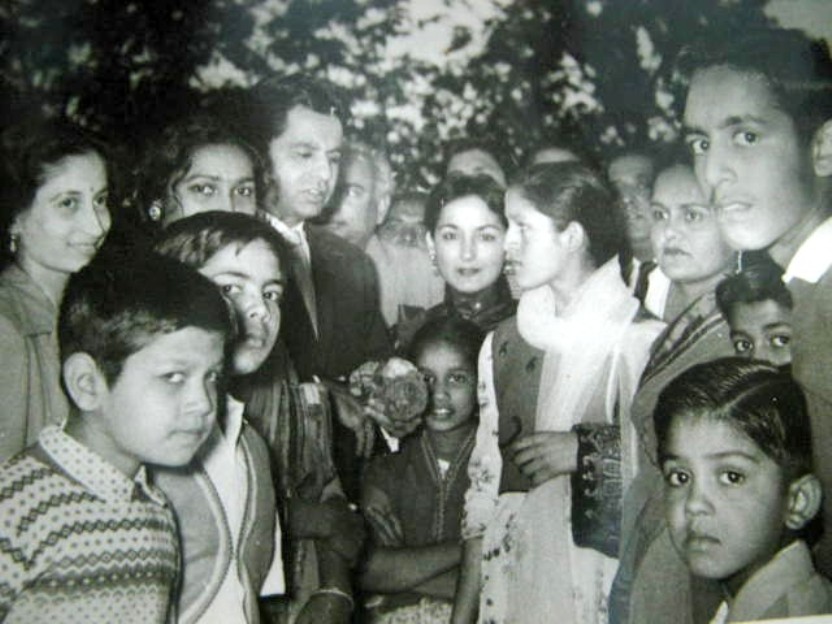
Photographs of Dilip Kumar when he visited Bhopal at the time of screening of Ganga Jamuna in early sixties.  This party was organized at Straw Products Lawn by Mizbah Sahib, the then manager of Bharat talkies.
Pic 1 : Javed Chisti Sahab attacking the table and Mr. Iqbal standing behind. He was in class 8th at that time.
Pic 2 : With Mizbah sahib.
Pic 5 : Mr. Iqbal and Haneef Bhai (Kale Khan & Mohammed Haneef) bidi wale.
Pic 6 : Extreme left front row Dr Mehboob Ahmed and 
Javed Chisti Sahab next to him. Some  other beautiful ladies of Bhopal who must be Dadi and Nani now.
Received with thanks from Mr. Javed Chishti

May 11, 2010

Bhopal Ka Babu

Bureaucrats in Madhya Pradesh have come clean on their immovable properties, well almost, but the exercise seems to have been moved more by the concern to hide than reveal much.

After a landmark verdict by the state’s Information Commission on February 15, the state government had asked bureaucrats, as also every government employee — barring Class IV — to post details of their immovable properties on the websites of their respective departments by April 30.

If the properties were sold for the rates listed in the column “present value” by some officers, it would surely have sparked off a crisis in the real estate market in MP. But most officers have either kept the column blank or maintained “present value not known” or not given details of the location of the property.

A flat in Bhopal or a plot in Indore is not saying much. A few have not revealed much by saying “according to market value” while some others have not bothered to share anything.

IAS couple, Arvind Joshi and Tinoo Joshi, who were suspended after I-T raids, however, are sure about their facts and valuations: Their 8.25 acre agriculture land near Bhopal has cost them Rs 1.25 crore and a 1400 sq-ft ‘super HIG’ flat in Delhi’s Dwarka locality Rs 50 lakh. At Rs 1.75 crore, the total value of the Joshis’ properties is much less than the Rs 3 crore in cash recovered from their government bungalow in the state capital in early February. The 1979 batch couple has not shared details of movable properties because it was not required.

Anju Singh Baghel, who was suspended for allowing exchange of prime government land with private land when she was posted in Katni as Collector, owns 30-acre land in Satna district, which is valued at Rs 20 lakh. She owns three more residential properties valued in all at Rs 21 lakh.

Dr Rajesh Rajora, who was suspended for alleged irregularities in the Health Department he headed in 2007 as Commissioner, does not know the present value of a four-acre property he owns near Bhopal.

Vishwapati Trivedi, who is on deputation to the Centre, owns a 2000 sq-ft plot in Vasant Kunj in New Delhi and a 350 sq-mt plot in Greater Noida, Uttar Pradesh, valued at Rs 6 lakh and Rs 3.69 lakh, respectively. Neither is up for sale.

The IAS officer owns 450 sq yd plot in Noida, valued at Rs 1,800 per sq m, and a 408 metre plot in Gurgaon, Haryana, valued at Rs 19.82 lakh. But then his present value column has a qualifier in bracket “acquisition value”. He had purchased the properties in the 1990s, but has not calculated the present value.

Many promoted officers have revealed more income than the direct recruits. In fact, the richest IAS officer, according to the details on the website, is Santosh Mishra with properties worth Rs 5.40 crore.

Congress leader Choudhary Rakesh Singh whose application under the RTI led to the verdict is not impressed with the details and alleges that the under-valuation is deliberate.

Elected representatives like him have a reason to complain because the affidavits they submit to the Election Commission before polls is much more revealing with details of vehicles and other investments, something the bureaucrats don’t have to do.

Following the ‘disclosure’ by bureaucrats, some legislators, including those belonging to the ruling BJP, have said the real purpose will be served only if the babus are asked to part with details of properties they acquired after joining the service.

State’s Chief Information Commissioner P P Tiwari, however, said the purpose of his verdict was served.
-http://bit.ly/d3CPho

May 10, 2010

At MANIT Bhopal

In a big clean-up act, HRD minister Kapil Sibal has approved cancellation of appointment of more than 60 teachers of the prestigious Maulana Azad National Institute of Technology (MNIT), Bhopal, who were recruited illegally in 2005. 


Sources in MNIT said 15 assistant professors and 47 lecturers besides training and placement officer and librarians would lose their jobs. Sources said many teachers did not even meet the criterion of basic academic qualification while some paid bribes to get the job. 

Sibal has asked officials to simultaneously rescind these appointments and begin fresh recruitment. However, officials at MNIT said they were still to et any communication from the HRD ministry. 

These teachers in the rank of lecturers and assistant professors (system of designation has since changed) have been working for the last five years. NITs, directly under the HRD ministry, are being modelled on the lines of IITs. 

"Reversal of appointments in such a large number will definitely harm the reputation of NITs,” an NIT director said. 

"What is shocking is that no action was taken despite a report by a fact-finding committee in 2008 against their appointment," he added. 

The issue of illegal appointments resurfaced when CBI sought HRD ministry’s approval to investigate the role of Rajneesh Shrivastava, currently director NIIT, Jamshedpur, in recruitment of an assistant professor when he was at MNIT, Bhopal. It came to notice that as per the directions of the ministry, MNIT had set up a fact-finding committee in 2007 that looked into irregularities in appointments including the one for which Shrivastava was being held responsible. 

The ministry then decided that since Shrivastava was not alone in taking the decision, it would be proper to deal with lacunae in appointments pointed out by the fact-finding committee. The committee had even suggested a separate inquiry to investigate allegations of bribery in appointment. Therefore, it was decided to cancel all the appointments.
-http://bit.ly/deJGjd

Apr 21, 2010

Bhopal: A Prayer for Rain


A film starring top Hollywood actors that dramatises the Bhopal gas disaster has been criticised by campaigners and participants in the tragedy for misrepresenting individuals and the facts.
Bhopal: A Prayer for Rain is due for release this autumn with Mischa Barton and Martin Sheen in leading roles.
Shot largely in India, it portrays the events around the world's worst industrial accident, in which clouds of toxic gas escaped from a chemical plant run by a part-owned subsidiary of American company Union Carbide.
More than 8,000 people, mainly living in slums around the plant, died immediately when the gas leaked shortly after midnight on 3 December 1984. At least 25,000 others are estimated to have died over subsequent years and many more continue to suffer today.
Ravi Kumar, the writer and director, said the film was "a dramatisation, inspired by real events.
"There are 18- and 19-year-olds across India and across the world who have never heard of Bhopal. I could have made a four-hour documentary that no one would have seen.
"This way a whole new generation will learn about what happened and a whole series of very important and relevant questions can be discussed," said Kumar, a London-based paediatrician who has raised more than $5m from Indian private backers for the project.
Sheen plays Warren Anderson, the chief executive of Union Carbide, headquartered in Danbury, Connecticut. Barton plays Eva Gascon, a fictitious reporter from Paris-Match who learns of the problems at the plant from a local journalist but decides not to publish a story.
The film ends with an imagined present-day meeting between Anderson and Gascon in the former's country club in America. The journalist is racked with remorse. Anderson is unrepentant.
Earlier versions of the script, obtained by the Guardian and Bhopal campaigners, have angered many.
"There is not a single Bhopali with upright moral standards in the script. Of course the people of the city are going to be angry. They are made to look comic, corrupt or passive victims," said Satinath Sarangi, managing trustee of the Sambhavna Clinic which helps the estimated 150,000 suffering health problems due to the disaster.
Raj Kumar Keswani, editor of a local newspaper in Bophal, who wrote a series of articles before the disaster outlining the danger posed by the plant, said reading the script had been "very painful".
Keswani, portrayed in the film as a foul-mouthed buffoon, said: "My sincerity, integrity and commitment has been distorted and trivialised [and] other characters of Bhopal have not been treated fairly." Kumar said he tried to contact Keswani before filming but had been rebuffed. The journalist said no such attempts had been made and that he was "always accessible".
The film is also likely to reopen debate over who was responsible for the disaster. Union Carbide Corporation (UCC), now owned by Dow Chemical Company, has always claimed that its Indian subsidiary Union Carbide India Limited (UCIL), 49% of which was owned by local Indian investors, was solely responsible for the operation of the plant and that the accident was the result of sabotage by an employee who has subsequently been identified.
Union Carbide denies any safety issues at the plant before the leak.
Kumar, who was born in Bhopal, said that the sabotage theory had been "totally discounted". His film instead shows an ill-equipped and poorly-trained Indian workforce struggling to work with badly maintained equipment.
Tim Edwards, of the International Campaign for Justice in Bhopal, said that despite serious flaws the film's script was "not all bad.
"It depicts the cost-cutting regime imposed by the parent UCC on subsidiary UCIL pretty well. There is also substance to the depiction of local management culpability. Overall, [the film] does make [Union] Carbide look like white-man's-burden colonialists who put big dreams and profits before practical worker health and community safety," he said.
However, Edwards said that the film "glossed over the degree of control and responsibility of US officials" and failed to portray strenuous efforts made by representatives of the workforce to get improvements on safety, particularly after a series of accidents and the death of at least one worker at the plant in the years before the accident.
Kumar said that Sheen had "sharpened" the character of Anderson, who is still alive, to make the message of the film "more black and white.
"Marty wanted him to be less ambivalent than in the original script.
"Now [Anderson] basically blames everything on the Indians and walks away," Kumar said.The Union Carbide plant in Bhopal was set up on an unpopulated site on the outskirts of the city in 1969 to manufacture pesticides for use in India's push to improve agricultural productivity. The city grew to envelop the plant, which started manufacturing the volatile chemical Methyl isocyanate, which forms toxic gas on contact with water, in 1979. Much of the action of the film takes place in the shantytowns which had grown up around the plant where most of the victims lived.
Hazra Bee, a resident of Bhopal whose grandchildren suffer serious birth-defects said that enough films had been made on the events leading up to the tragedy. The most important thing now was to highlight the ongoing consequences of the disaster, she said.

Apr 11, 2010

Bho Pal


We’ve heard about campism in Bollywood, and of late there are certain actors who seem to have bonded well - Katrina Kaif, Ranbir Kapoor and Arjun Rampal.

The three kept pulling each other’s legs and having a good time on the sets of the serious film Rajneeti directed by Prakash Jha. In fact they got along like a house on fire, and have even kept a name for their ‘gang’. “We call each other ‘Bho-pals’! We shot Rajneeti extensively in Bhopal, and actually became friends there, so the entire team is called ‘Bho-pals’,”explains Arjun. As Bollywood defines it’s friendship lines, we give a thumps up to a new Bhopal oops’, Bho-pals.

Mar 25, 2010

Bhopal Ki Beti

Snubbed by the CPM, the jamai raja could now bond with his sasural.

Amitabh Bachchan, who was rejected by the Left party as brand ambassador of communist Kerala because he has taken on a similar role for Narendra Modi-ruled Gujarat, has been requested by wife Jaya to firm up ties with Madhya Pradesh, the state where she grew up and lived for much of her early years.
Jaya, now a Rajya Sabha MP of the Samajwadi Party, unilaterally offered to convince her husband to help voice the story of the river Narmada, a main tributary in the state, and spread awareness about water conversation.

The actress was speaking at the valedictory session of the three-day Second International River Festival 2010 on the banks of the Narmada at Bandrabhan, about 90km from Bhopal.

Jaya said that as the “daughter of Madhya Pradesh”, she would be delighted to hear Bachchan’s baritone as part of their contribution to the “Save Narmada” campaign.

“I feel the story of the Narmada river should be recorded in Amitabh Bachchan’s voice. This way, the new generation can know about the Narmada and make people aware about the environment,” said Jaya.

Her remarks triggered speculation on whether the Bachchans were hoping to renew their links with Madhya Pradesh.

Jaya, a Bengali by birth, belongs to Bhopal, having studied at St Joseph’s Convent there before joining the Film and Television Institute of India in Pune.

Her father, the late Taroon Coomar Bhaduri, was a Calcutta newspaper’s special representative in Bhopal in the late ’50s and ’60s.

Bhaduri was also an accomplished writer and a stage artiste. His Bengali novel Abhishapta Chambal (Accursed Chambal) has been translated into several languages. Bhaduri had served as chairman of the Madhya Pradesh Tourism Corporation during the regime of Arjun Singh.

The ruling BJP in the state is willing to take up Jaya’s offer. Culture minister Laxmi Kant Sharma described Amitabh as Bhopal’s “jamai raja” (son-in-law) who had a special bond with the state.

“We are seriously considering thinking in this direction. In case Amitabh Bachchan agrees, it will be a matter of immense pleasure and pride for the people of the state and all of us,” he said.

The minister, however, hastened to add that a final decision would have to be taken by chief minister Shivraj Singh Chauhan, who, like Narendra Modi, has steered the BJP to poll victories but unlike the Gujarat leader, enjoys wider acceptability among the masses.

Bachchan incidentally has time and again identified himself as the “jamai raja” of Bengal and has even offered to be brand ambassador of Orissa because it is a neighbour of the state.

State Congress leaders interpreted Jaya’s remark as a sign of Bachchan’s bid to move closer to the BJP following the exit of close friend Amar Singh from the Samajwadi Party.

In January, the actor’s visits to Gujarat and Karnataka had sparked speculation on whether the Big B was again treading a “political path”. Bachchan had flatly denied any such move, pointing out that he had approached the Gujarat government with a request for exemption of entertainment tax on his film Paa which dealt with a rare genetic disorder.

Bachchan, in his blog today, took potshots at the CPM — without naming the party — for objecting to his association with Kerala.

“You want to stop me from promoting tourism in a state, because you have reason to believe that there are political connotations to the event. This is such rubbish! All I shall be doing will be working in a short film that shall highlight the various places of interest in the state, so that it encourages more tourists to visit the region…

It is a petty act of cheap convenience to prevent me from doing that, and by pitting me against political connotations and manoeuvres without paying any respect for the actual work that would be done….I shall abide by the judgement of the state government. I did not ask them for it, they came forward with the invitation, I accepted, now they want to decline it, fine…”

At Bandrabhan, Jaya spoke of the need for water conservation, recalling days when people drank unfiltered water straight from hand pumps and taps. “We cannot even think of doing so today. We fear we will die,” she said.

Describing her fond memories of the hills and lakes associated with Bhopal, she rued that the place has changed beyond recognition. “First we tamper with the environment, exhaust all our water and then search for water on the moon,” she said.

Mar 9, 2010

A Post Veer Revisit To Bhopal's History and Pindaris

Recently Salman Khan acted and produced a film called Veer, which revolved around the Pindharis. Pindharis belonged to the valleys of Narmada, and Bhopal staged many Bhopale Pindariimportant episodes of their life. This is my attempt to reconnect these episodes.
“Their (Pindaris) true history has perhaps not yet been written. The profuse British accounts suffer from a natural bias created by the last years of their activities perpetuating the impression that the Pindaris were the enemies of society and such loathsome pests as deserved to be exterminated.” G. S. Sardesai, Maratha historian.
Bhopal founder Dost Mohammad Khan  was succeeded by Yar Mohammed Khan - his son. His two successors  - Faiz Mohammed Khan and Haiat Mohammed Khan,  proved to be utterly incompetent,and both devoted themselves to a life of religious austerity and seclusion. Their ministers were therefore the real masters of the state and the post of dewan was the object of frequent contest.

During this period two Pindari leaders, Hiru and Barun,sons of Shahbaz Khan,offered their services to the Nawab of Bhopal. Shahbaz Khan organized one of the main division of the Pindaris, generally connected with Sindhias of Gwalior. Shahbaz Khan died in a campaign in Sindhia's service, but his group continued their association with the house of Sindhia. During the chaotic phase of Bhopal there was hardly a person who could take any decision. When no decision was seen for some period, the Bhonsla family at Nagpur hired the two brothers. The Pindaris' first assignment, which they executed with enthusiasm and success, was to plunder Bhopal. However, jealous of the wealthy loot accumulated in this assignment and siding with Hiru in a dispute, the Bhonsla Raja plundered the Pindari camp and took Barun prisoner. Hiru fled back to Sindhia uncertain of his own safety. Both leaders died shortly afterwards in 1800.

Meanwhile in Bhopal Chotey Khan became the all powerfull diwan (Chief Minister). He fought the battle of Phanda, thrust upon him by Bahu Begum. His son was made diwan after his death by Nawab Hayat Mohammad Khan. Amir Khan, Son of Chottey Khan, and his brothers conspired with the Scindias, raided the treasury, made off with 1½ lakh cash and took refuge with Daulat Rao Scindia. Amir eventually persuaded Daulat Rao Scindia to invade Bhopal with force of 49000.Nawab Hayat Mohammad Khan was in no position to oppose and conceded the forts of Hoshangabad and Raisen.

The saviour appeared in the form of Wazir Mohammad Khan. After the death of Murid, Wazir Mohammed imitated the example of Sindhia and Holkar, and started supporting his army by similar acts of aggression to his neighbours. During this period a Pindari by the name Karim Khan tried to get into Bhopal. Karim Khan was briefly the wealthiest and most powerful Pindari leader. As a young soldier, he successively served under the Peshwa, Sindhia, and Barun. When the Bhonsla Raja took Barun prisoner, he fled and served under Sindhia. In the wars against Hyderabad, especially at Kharda (1795), he amassed a fortune in plunder. To safeguard this newly acquired wealth, he established himself at Shujaulpur in central India. There he attracted a large Pindari following. Later, in 1804, Sindhia confirmed his possession of this land which was worth 15 lakhs of rupees annual revenue. Seeking to set himself up as a prince, Karim Khan tried to expand unsuccessfully into Bhopal. In 1806, Sindhia, fearing Karim Khan's expansionist ambitions and growing power, enticed him to his camp and took him prisoner. Karim Khan's mother fled with her son's wealth to the prince of Kotah, Zalim Singh. During the next five years, Karim Khan remained a prisoner of Sindhia while other Pindari leaders continued to expand their power.
Chitu, the other outstanding Pindari leader of the Independent Period, was born a Jat near Delhi. Dobble Khan, whose sons led Barun's durrah, bought Chitu as a slave and then adopted him as his son. Eventually Chitu acquired the leadership of Barun's group. Like Karim Khan, Sindhia gave Chitu a title and lands in 1804, but also took him prisoner in 1807.

Meanwhile in Bhopal, Nawab Ghous Mohammad Khan, the heir apparent, engaged in  treacherous deals with Marhattas of Gwalior and Nagpur. This left the British unsure of Bhopal’s commitment to resisting Marhatta power, while Wazir was negotiating with the Britishers for a treaty that would give Bhopal protection against its neighbors. Hayat died on 17 November 1807, aged 73, and Ghous Mohammad Khan succeeded him 18 days later. Soon Raghuji Bhonsle sent a force of 40,000 under his able general, Sadiq Ali. Sadiq Ali took over Bhopal and demanded that Ghous hand over Wazir and his wife as hostage. No sooner had Sadiq Ali left Bhopal than Wazir swooped down from Ginnor fort and routed the Nagpur forces and resumed governance of Bhopal.

On payment of a large ransom, Sindhia released both leaders, Chitu and Karim Khan, in 1811. During the Dusshera festival they planned to join forces against Sindhia and the Bhonsla. As has already been mentioned, the Bhonsla bought off Chitu with grants of land. Chitu then joined Sindhia by helping his officer, Jago Bapu, defeat Karim Khan. Karim Khan fled to Zalim Singh for protection. At the same time Sindhia threatened Zalim Singh with reprisals if he gave Karim Khan asylum. Karim Khan finally turned to Amir Khan and Holkar for help. They negotiated a settlement, by which Karim Khan remained under their confinement until 1816. When he obtained his freedom in that year. he again attempted a union with Chitu for a common defense against the British. Quarrels between the two prevented such an alliance. Namdar Khan and Wasil Muhammad were among the leaders of smaller durrahs during this Period. As Karim Khan's nephew, Namdar Khan occasionally plundered Sindhia's territory to avenge his uncle's subjugation. His durrah numbered only about 2,000 men compared to the 10,000 of Karim Khan's. Wasil Muhammad, who was a son of Hiru, generally remained loyal to Sindhia with a durrah of 5,000 men.

The Marhatas were furious at Wazir’s presumptuous counter-attack. Accordingly Gwalior and Nagpur jointly resolved to defeat Wazir and carve up the state of Bhopal among themselves. Wazir sought Bhopal’s salvation in British support, sent numerous messages to the Governer-General and to British army commanders soliciting a treaty of friendship. The British were initially inclined to respond to Wazir’s entreaties but drew back from committing their support, partly because they did not entirely trust Wazir and partly because they hoped to neutralize the Marhattas by compromise. When Gwalior and Nagpur armies, numbering 82,000, converged on Bhopal on 15 October 1812, Wazir stood virtually alone. He could muster up only 11,000 able bodied fighters, which included three thousand were Pindaris, commanded by Namdar Khan, a nephew of Kareem Khan. A few weeks into the siege, Wazir’s allies, the Rajput, sikh and some Pindari forces decided to quit and withdraw from the fort. The Bhopal forces were now reduced to 6000. The seize of Bhopal continued for about nine months, by the end of which Bhopal state was reduced to 200 men and women manning the fort. At end Sadik Ali lost his patience and abandoned the Siege. His departure destroyed the hopes of Sindhia's forces, already dispirited by the duration, and events of the siege; they accordingly followed the example of the Nagpur troops, and marched to Sarangpur, where they were stationed during the rains. (Check related details)

When the regular forces of the Marathas had been broken up in the campaigns conducted by Sir Arthur Wellesley and Lord Lake, the Pindaris made their headquarters in Malwa, under the tacit protection of Maratha Dynasties like Sindhia and Holkar. Many Pindari leaders owned lands in the Narmada valley. On these lands their families and followers subsisted when they were not plundering. Other lands were located within the territories of the ruler who employed or supported Pindari leaders. Many of them were within the territory of the Nabab of Bhopal, and it was from this area. which included Nemawar, Sutwas (don't know where is this?), Raisen and Bhilsa (Vidisha) that the Pindaris conducted their raids. They were accustomed to assemble every year at the beginning of November, and went into British occupied territory in search of plunder. In one such raid upon the Masulipatam coast they plundered 339 villages, killing or wounding 682 persons, torturing 3600 and carrying off property worth a quarter of a million pounds. In 1808-09 they plundered Gujarat, and in 1812 Mirzapur. In 1814 they were reckoned at 25,000 to 30,000 horsemen.
Although the attack of Bhopal was thus repelled, there was every appearance of its being speedily and successfully resumed. Meanwhile Lord Hastings, with the approval of the Court of Directors of the East India Company, decided to exterminate and eliminate the Pindaris in September 1816. Hastings put into place a plan by the end of 1817. To begin with, he entered into an understanding with several other powers active in India. The eminent war between Bhopal state and Marathas was prevented by the treaty between Wazir's son Nazar Mohammad Khan and the East India Company in 1818.  This organized campaign of Lord Hastings was known as the Pindari War or the Third Anglo-Maratha War.

Chitu fled to Bhopal, where he tried to reach an agreement with the British through theBhopale Pindari 3 Nawab. The British rejected his plans as too extravagant. Karim Khan's group split into three bodies, but the British troops still detected them. Clarke's cavalry attacked one group around Gangraur, while Adams pursued the rest into the Bhopal area. Soon, most of the Pindari leaders surrendered to the British authorities. Namdar Khan gave himself up on February third, and Karim Khan surrendered to Malcolm on the fifteenth. Others gradually followed their example.

Only Chitu escaped. He participated in the events connected with Appa Sahib at Nagpur but eventually fled to the jungle, deserted by his followers. Near the end of February 1819 his body was brought to Malcolm. He had been attacked and killed by a tiger.

John George arranged for the Pindari leaders and their families to settle in northern India at Gorakhpur with pensions and land. To prevent any resurgence of the Pindaris, the British permitted only Namdar Khan, Karim Khan's nephew, to settle in Bhopal near the old banes of the Pindaris.
In conjunction with British consolidation after the war, John Malcolm arranged for the Pindari leaders and their families to settle in northern India at Gorakpur with pensions and land. To prevent any resurgence of the Pindaris, the British permitted only Namdar Khan, Karim Khan's nephew, to settle in Bhopal near the old banes of the Pindaris.

Bhopale Pindari 2 About a century later a Gorakpur gazetteer reported the inglorious history of the Pindari descendants and their land. The land had passed from rent-free to assessed land though the revenue was very low. The descendants lived in pretentious opulence with the title of Nawab, which the Government refused to recognize. Though a few leaders, such as Sheikh Dulla, continued to plunder the Deccan areas during the 1820's, their followers were few and their devastation minimal. By 1825 Malcolm reported that most of the Pindaris had become absorbed into the general population of central India. He found it difficult to trace them.


In 1866 Alfred Lyall wrote in "The Old Pindaree" of laments of Pindaree, the fiercely independent fighter/pluderer from central india: 

And if I were forty years younger, with my life before me to choose
I would'nt be lectured by Kafirs, or bullied by fat Hindoos;
But I'd go to some far-off country where Musalmans still are men
Or take to the jungle, like Cheettoo, and die in the tiger's den.

Other groups and events now occupied the center of the Indian stage of history.

Bhopal : A Prayer for Rain

Bhopal : A Prayer for Rain, a film on the Bhopal gas tragedy of 1984, was declared tax-free in Madhya Pradesh by chief minister Shivraj ...