May 31, 2009

Kochi To Bhopal

The old joke about Malayalis is that when Neil Armstrong set foot on the moon, he met a Malayali tea seller. The Sunday Express only had to go as far as Raisen district in Madhya Pradesh to find four villages, where the natives of Kerala set foot in 1955 as part of a Central government scheme. 

  
February 10,1955. Gopalan sat huddled 
on the platform at Kochi Harbour Station, waiting for the train to New Delhi to pull in. As the 22-year-old waited, he held on to a clutch of marachini kambu (tapioca). An unexpected call of destiny in the form of a newspaper advertisement had intertwined his life with the tapioca he held on to—uprooted from his home in Thonnakal, about 24 km from Thiruvananthapuram, Kerala, and about to be transplanted in a village called Intkheri, 90 km from Bhopal. 


Fifty-three years later, Gopalan doesn’t remember what he did with that bunch of tapioca but as he talks about “Jawaharlal Nehru’s plan” that brought 200 families from Kerala and relocated them in Intkheri and three other villages, he realises his memory hasn’t failed him through these difficult years. “How can we forget? It wasn’t easy. About 19 families went back soon after and others left over the years. Now there are about 100 families left in these four villages,” says Gopalan (now Gopalan ‘Patel’), laying out yellowing pieces of official documents and newspaper reports that put together a curious story—of human grit, of migration and a beautiful chronicle of social 

transformation that brought a piece of Kerala to the heart of Madhya Pradesh. 

  
Intkheri, the biggest Malayali settlement in the region, announces itself much after you turn right from National Highway-86, along a dirt track with spiky boulders for a road. When it rains, the spikes jut out menacingly and the nearby Chamarsal river, a tributary of the Narmada, threatens to breach its embankment and cut off Intkhedi and its sister villages. It’s almost as if the rains conspire to make this part of an India that is forced to move at a different pace. The other villages—Imilia, Uradmao and Majoos Kalan—fall in a line, separated by rows of soyabean fields and joined by a history that goes back 53 years. 


In 1955, a number of landless families—mainly Ezhavas and Nairs (two of the biggest Hindu communities of Kerala) and Christians—were brought from Travancore-Cochin state (before it became Kerala) and given land in then Bhopal state under a Central Mechanised Farming project. The biggest lure for these poor families from places like Kuttanad, Aluva and Trissur in Kerala was the 12 acres that each of them would get in four villages—Intkheri, Imilia, Urudmao and Majoos Kalan—in Raisen district. They also got, among other things, a pair of bulls, a plough, seeds for sowing and an igloo-shaped, tin-roof barrack, the money for which they had to pay in easy installments. According to the initial terms of agreement, the selected people would be employed on daily wages to work on the farm for two years, during which they would be trained to sow and harvest wheat and soyabean and they in turn would teach the native tribals paddy cultivation. The land would be transferred to them at the end of the 10th year after they paid the prescribed premium. 
But things didn’t quite work according to plan. After the reorganisation of states on November 1, 1956, Bhopal state became part of a greater Madhya Pradesh and the project wound up in 1957—eight years ahead of schedule. According to the settlers, the pending installments were calculated as dues and thrust on them. 


O.N. Shrivastava, former Governor of Nagaland and Manipur and an IPS officer of the Madhya Pradesh cadre, says the project was probably stopped because the new state had an entirely different set of administrators and several old projects were stopped. The farming project at Intkhedi probably ended that way, he says. 

a8c123b8-2f69-11de-9471-000b5dabf613.jpg
  
“That came as a shock. We were suddenly branded as debtors and could no longer avail of loans. We struggled for years on this alien land and all those people who were supposed to implement the project vanished. We have worked on paddy fields back home but wheat was entirely new. So each time we tried, we failed,” says Gopalan, whose family owns 14 acres in Intkheri. 


All this while, the debts kept mounting and a lot of settlers went back to Kerala, putting up their land for distress sales. In 1970, after several requests to ministers and officials of the state government went unheeded, Gopalan and others wrote to then prime minister Indira Gandhi. That worked. In 1984, the Centre waived their loans—close to Rs 5 lakh—and the Malayalis won their first battle. 


But while they were battling loans and writing memorandums, Intkheri and the other three villages witnessed a quiet social transformation. When the first set of 71 Malayali families came on May 1, 1955, the locals—mostly Gond tribals and other OBCs like Naees and Kushwahas—resisted. “We would run away from them. We didn’t know where they had come from. They looked different, spoke a strange tongue and ate huge mounds of rice. Our parents were convinced they were barbarians. But that was then. Now the joke is that we wear lungis and they wear pyjamas. We look like each other now,” says Hari Ram Kushwaha, the sarpanch of Intkheri, which has a population of 1,150 and 50 per cent of them are Malayalis.


THE physical divisions blurred over time but what was tougher to overcome were mental blocks—like that of caste and religion. These villages had very few upper caste but untouchability was well entrenched among the locals. “Those days, there were only two wells in Intkheri,” says Karthikeyan, the secretary of the village panchayat. “The locals wouldn’t let us draw water from their wells. And if we touched any of their mud pots, they would fling it on the ground and break it. But now we are invited to their weddings and we all sit and eat together. Since we are all agriculturists, we share the same concerns,” says Karthikeyan, who came to the village as a child. “I was 14 when these people came. We would call them ‘Madrasis’. I don’t quite like the word but…” So what does he like calling them? “Malayali,” says Kushwaha, taming the syllables and pronouncing the word like very few non-Malayalis can. “I can also speak a few lines: Ninde pere enda (What’s your name?), nee evede pova (where are you going?),” Kushwaha grinned.


And so gradually, the Malayali families got the primary school in the village upgraded to a higher secondary school, set up two churches, first a Pentecostal and then a Catholic church, a primary health centre, even a Chotanikkara Bhagawati temple based on the original one near Ernakulam in Kerala and a Sri Narayana Guru temple dedicated to a great social reformer in Kerala—everything except what we were by now half-expecting to find: that card-carrying union leader. 


“Oh, no unions here. Some of our families were loyal to the Communists. But since Nehru got us here, they switched sides to back the Congress,” says Karthikeyan.


E.V. Joy, a grocer opposite the Catholic church, then gives us a crash course in local politics. “In the last assembly election, a Congressman won from our constituency, Bhojpur. We are part of the Vidisha Lok Sabha constituency and Thakur Rampal Singh of the BJP is our MP,” he says. And then, the stunner: “Your newspaper’s founder, Ramnath Goenka, was an MP from Vidisha. I know because I read the papers.” Have to hand it to the Malayali. 


BUT the most visible change was literacy. When the Malayalis of Aluva and Kuttanad carefully packed their sparse belongings, they also made sure they brought with them a fierce obsession for education. Like 75-year-old Mariakutty, who says her only aim in life when she came as a 22-year-old was to make sure her four children went to school. “When I came here, I was shocked. The school wasn’t good enough and I would cry all day. I felt trapped but held on, somehow.” Now as Mariakutty’s granddaughter waits for her admission card from a Raisen college, she is relieved. “My husband died about nine years ago and now all I want is to see these kids educated,” she says. It is hard to say if her eyes are moist with tears or glazed with age. 


Like Mariakutty, the Keralites in Intkheri and the other three villages ensured that every child in their homes went to school—fueled by an intense aspiration to make life better for their children. Some even sent their kids to English-medium schools in Raisen (35 km away) and Bhopal because the school in Intkheri wasn’t “good enough”. A few families sold their land to afford their children’s education and some relocated with their kids to Bhopal. 


“We started sending our children to school after seeing the Malayalis. But we still wouldn’t send our girls outside these villages,” says sarpanch Kushwaha. 


This paid off: Intkheri has a literacy rate of 100 per cent while nearby villages with no Malayalis like Kosni and Bhartipur have a rate of about 20 per cent. 


But at the government high school in Intkheri, it’s hard to find Malayali children. “You won’t find too many of them here because they all stay in hostels in Raisen, Sultanpur or Bhopal. Malayalis want English-medium schools for their children,” says Usha Mohan, a 37-year-old teacher from Imlia village who teaches in the Intkheri school. “As kids, we walked all the way from Imilia to study here. Aise mushkil paristithi mein padayi karoge, tabhi jakar apan zindagi mein kuch ban payenge (if you want to make a mark, you will have to struggle to study),” she says. I cringe but don’t tell her my child goes to a premier school in a fancy yellow bus but still complains about being taken to school. And then a stumper: “Acha, yeh batao, yeh sab likhne se apan ko kya milega,” she asks. “Hmm…” we smile foolishly. 


Apan is an MP slang for ‘us’ and Mohan, a second generation Malayali here, speaks the regional dialect with ease but surprisingly, with a pronounced Malayalam accent. So do all the second and third generation Malayalis here. Like Mariakutty’s 15-year-old granddaughter Roma Jacob says, “The local girls make fun of our accent. But I think they speak funny Hindi.” 


“It’s probably because when we came here, we lived in clusters, away from the locals,” says Karthikeyan. Now though the Malayalis and the locals get along well, Intkheri, Imilia and the other villages have their Malayali colonies. “The Malayalis have maintained their identity all along. There have been no cross-marriages so far. Even the Ezhavas, Nairs and Christians don’t marry each other,” says Father Philip, the priest at the Catholic church in Intkheri. 


Food habits have changed over time but rice is still the staple, at least among the older lot. “We have to eat rice, even if it is once a day,” says 55-year-old Shanta Nair who came here as a two-year-old with her father. “For Onam and Vishu (Kerala’s two main festivals), we get jaggery chips and nentra payam (a plantain variety popular in Kerala) from Bhopal and invite our relatives in Bhopal and surrounding areas,” she says, running her fingers through her knee-length damp hair. The smell hits me every time she does that: it’s that familiar mix of coconut oil and water, just the way Malayalis like it. “And why shouldn’t it be? We are Malayalis, aren’t we,” she asks. But Shanta and the others barely visit Kerala. “I did go 25 years ago. I felt completely cut off—barely knew anyone. I don’t think I will go again,” she says. 


That’s the story of Intkheri and the other three villages—a story that began when Gopalan Patel, Shanta’s father and many others set out in search of a new home. But 53 years later, they still haven’t found their home: is it that faraway, surreal land called Kerala they left long ago, or in Bhopal and Raisen where several families have since migrated to, or here in Intkheri and Imilia, where an entire generation has grown up? 


“Home is definitely here in Imilia. This is where we toiled, where we own land, this is what we will leave behind for our children. But sometimes, when I see my grandchildren walk miles to get to their school, when I think of whether, if I were to fall ill, I will survive the trip to the hospital in Sultanpur, I sometimes wonder if my husband did the right thing by choosing to come here,” says Shankariamma, teacher Usha Mohan’s mother. 


“Please do write about all this: that we have no roads, no good health centre…,” says her neighbour Chellamma. “Yeh sab likhne se apan ko kuch faida hoga,” she asks. 


Thankfully, Chellamma doesn’t insist on an answer.


Photographs: Liz Mathew
Article: Uma Vishnu
May 23, 2009

Bhopal At The Big Picture

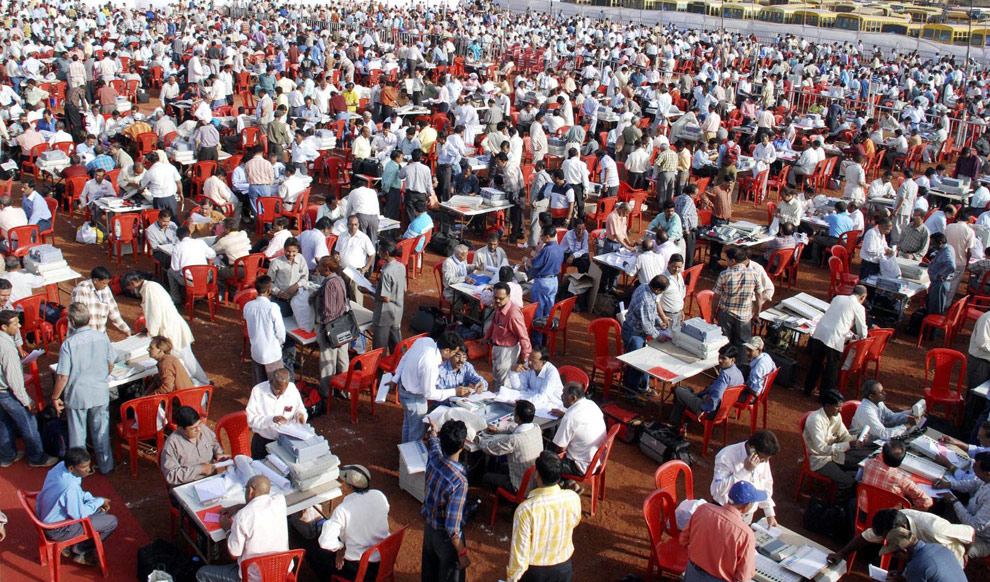
Polling officers check Electronic Voting Machines at a distribution centre in the central Indian city of Bhopal April 22, 2009. (REUTERS/Raj Patidar) #
More amazing pictures of General Elections 2009

May 18, 2009

Getting To The Top

The people of Sehore, a small town in Madhya Pradesh just 35 km away from Bhopal, have another reason to be proud. Until a few weeks ago, the local people would boast of two things: one, that in 1824, the man who fought and died in what they believe is India’s first war of Independence against the British, Kunwar Chain Singh, lies buried in their town. And two, that former Vice President, Justice Mohammed Hidayatullah, studied in Sehore. Now they have another boast, that a young woman, daughter of a laid-off worker, has got into the Indian Administrative Service.


Priti Maithil might not be one amongst the three women who topped this year’s examination to the civil services but even holding the 92nd position is an incredible achievement. At 23, she got through the examination in the first attempt. Her father, Santosh Kumar, has been unemployed since 2002 when the Bhopal Sugar Industries where he worked closed down. One of the principal reasons for the closure, locals tell you, is because there is no water in Sehore. So how can industries run? This is the story of so many smaller towns where sources of employment dry up even as basic services such as water and electricity evaporate.

Bleak prospects
Yet, towns like Sehore have so much going for them, apart from history. They boast of a good education system, one that can produce people like Priti. But the tragedy is that scores of young people emerge from similar towns, with education and dreams, but few prospects.

But coming back to this year’s civil service examinations, it is interesting that the media made much of the success of the three women who held the top three ranks. Shubhra Saxena, Sharandeep Brar and Kiran Kaushal were interviewed and featured on front pages of many newspapers. But will this alter the realities they will face once they enter the service?

Not all women in the Indian Administrative Service think that gender is a problem. But many do. Some of them have openly spoken about it in the media. In some States, like Maharashtra, the women officers have come together at various times when they have felt that they are being overlooked for promotions. At such times, the issue of their status within the service becomes the subject of some discussion. But whether it leads to sustainable change in the way the service is run is still an open question.

Welcome changes
Some things have changed. Veena Sikri, who was in the Indian Foreign Service, writes about how, in 1971, when she entered the service, married women were not allowed. She had to get special permission to get married! She says that many women left the service when they got married.

Just 30 years ago, women officers like C.B. Muthamma had to fight long legal battles that went up to the Supreme Court because they were denied promotions to the rank of Secretary. Veena Sikri was also superseded to the post of Foreign Secretary and she has still not been given the reason why the government did this. She now teaches at Jamia Milia University in New Delhi.

The success of the three women toppers has also brought into the public realm the views of women in the services. Many of them remind us that it is still tough for them to succeed. The issue is not just of the double burden they must carry — of being wives and mothers and professionals. They have to confront a bias that has everything to do with their being women and nothing to do with their competence.

An IAS officer from UP is quoted in Asian Age (May 10, 2009) as saying: “All this talk of women making their presence felt in cadre services is humbug. Women are still discriminated against by their male colleagues in States like Uttar Pradesh. If a woman officer interacts with her male political boss for official purposes, she is linked romantically with him, but when male officers interact with a woman politician, there is no such allegation. A woman officer is made to work twice as hard to prove that she is half as good as her male colleagues.”

The views of this particular officer might not be universal and there are many women who deny facing any discrimination. Yet even a few voices like this suggest that it is not entirely a level playing field once women enter even though they get in through open competition and without any special concessions made to them because of their gender.

Yet, even if women officers face problems, there is no doubt that the civil service still provides a unique opportunity for real “service”. An honest and concerned officer can make a spectacular difference to the lives of people, especially when posted in the districts. Whenever you travel to district towns, you constantly hear stories of such officers. They are long remembered even after they have moved on to other posts.

Fondly remembered
In Nawada in south Bihar, for instance, people still talk about N. Vijaya Lakshmi, who is now Excise Commissioner in Patna. During her posting in Nawada, she was fondly remembered for her interest in a range of local issues. The person who remembers her most is Veena Devi, the Mukhiya of Loharpura panchayat. She recalls how in her first term as a Mukhiya, when she was diffident and overwhelmed by the system, Vijaya Lakshmi would urge her to speak up in the male-dominated panchayat meetings. As a result, this semi-literate widow is now an outstanding leader in her area, and recognised as someone who holds promise for a future in politics.

A day may well come when the media does not consider it so remarkable that women top the civil service examination. But till then, each time women do make it to the top we are reminded of the rough road the majority has to travel, particularly when they are poor like Priti Maithil.

- Kalpana Sharma

May 11, 2009

THE GRASSHOPER

OLD VERSION
The Ant works hard in the withering heat all summer building its house and laying up supplies for the winter.
The Grasshopper thinks the Ant is a fool and laughs & dances & plays the summer away
Come winter, the Ant is warm and well fed. The Grasshopper has no food or shelter so he dies out in the cold.

MODERN VERSION
The Ant works hard in the withering heat all summer building its house and laying up supplies for the winter.
The Grasshopper thinks the Ant 's a fool and laughs & dances & plays the summer away.
Come winter, the shivering Grasshopper calls a press conference and demands to know why the Ant should be allowed to be warm and well fed while others are cold and starving.
NDTV, BBC, CNN show up to provide pictures of the shivering Grasshopper next to a video of the Ant in his comfortable home with a table filled with food.
The World is stunned by the sharp contrast. How can this be that this poor Grasshopper is allowed to suffer so?
Arundhati Roy stages a demonstration in front of the Ant's house .
Medha Patkar and Tan Shyamoli go on a fast along with other Grasshoppers demanding that Grasshoppers be relocated to warmer climates during winter.
Amnesty International and Koffi Annan criticize the Indian Government for not upholding the fundamental rights of the Grasshopper.
The Internet is flooded with online petitions seeking support to the Grasshopper (many promising Heaven and Everlasting Peace for prompt support as against the wrath of God for non-compliance) .
Opposition MPs stage a walkout. Left parties call for "Bharat Bandh" in West Bengal and Kerala demanding a Judicial Enquiry.
CPM in Kerala immediately passes a law preventing Ants from working hard in the heat so as to bring about equality of poverty among Ants and Grasshoppers..
Lalu Prasad allocates one free coach to Grasshoppers on all Indian Railway Trains, aptly named as the 'Grasshopper Rath'.
Finally, the Judicial Committee drafts the ' Prevention of Terrorism Against Grasshoppers Act ' [POTAGA], with effect from the beginning of the winter.
Arjun Singh makes 'Special Reservation' for Grasshoppers in Educational Institutions & in Government Services.
The Ant, fined for failing to comply with POTAGA and having nothing left to pay his retroactive taxes, its home is confiscated by the Government and handed over to the Grasshopper in a ceremony covered by NDTV.
Arundhati Roy calls it ' A Triumph of Justice ' .
Lalu calls it 'Socialistic Justice'.
CPM calls it the 'Revolutionary Resurgence of the Downtrodden'
Koffi Annan invites the Grasshopper to address the UN General Assembly.

NEW VERSION
Many years later

The Ant has since migrated to the US and set up a multi-billion dollar company in Silicon Valley.
100s of Grasshoppers still die of starvation, despite reservation, somewhere in India....
Because of losing lot of hard working Ants and feeding the Grasshoppers, India is still a developing country!!!

Apr 28, 2009

FROM THE LAND OF DOST MOHAMMAD KHAN

Decades before the cartographer sliced the subcontinent into Pakistan and India, ancestors of Kalyan Singh demonstrated the wanderlust typical of the Sikh community. They settled down in the green, picturesque Ferozkhel valley of Orakzai, one of the seven autonomous agencies which together comprise what is now called the Federally Administered Tribal Area (FATA). In his own 45 years of life, Kalyan had never experienced religious discrimination. He ran his business, lived a contented life with his family. And, despite the intolerance now sweeping across a swathe of FATA, Kalyan Singh would have told you, had you ever asked him, that the sturdy Pashtuns are hospitable, caring and kind-hearted.

Kalyan Singh’s feelings are now memories, his bucolic life in complete disarray. Much of Orakzai began to change when, early in 2008, Tehrik-e-Taliban leader Baitullah Mehsud’s men swept in here from South Waziristan through the neighbouring North Waziristan, inaugurating a reign of terror. Soon, Hakimullah Mehsud, Baitullah’s deputy, established an ‘Islamic emirate’ here, evoking horrific images of religious intolerance that scared a few Sikh families into migrating to Peshawar.

Kalyan Singh refused to shift out from what he saw as his ancestral home, believing he was safe living among the Orakzai tribals. But then, a fortnight ago, Hakimullah descended on the Ferozkhel valley and ordered members of the Sikh community, including women, to gather in an open area. They were told they were now in the custody of Taliban, and that they must pay jazia (a religious tax imposed on non-Muslims living under Islamic rule in the medieval times) or convert to Islam.

The soldiers of the Islamic emirate then picked up Kalyan Singh, tortured him in custody for 10 long days even as negotiations for the amount to be paid as jazia kept apace. Herjeet Singh, a local Sikh, quotes an eyewitness to say, "The militants convened a shura of their own and passed the verdict that Sikhs should pay Rs 100 million as jazia. Our elders pleaded that poor members of the community have no means to raise such a huge amount." Herjeet is among those who sneaked out of Orakzai before jazia was imposed.

The Sikh community’s plea prompted further talks, with the Taliban scaling down their initial demand to Rs 40 million, ultimately agreeing to Rs 12 million as the jazia, a source told Outlook. Kalyan Singh was then set free and asked to raise the demanded amount. His and 50 other families were held hostage. They were warned that any attempts to escape would lead to the slaying of men and conversion of children and womenfolk to Islam. "This is unheard of. Our forefathers lived among the Pashtuns for centuries and were never subjected to such humiliation and barbarism," laments Herjeet Singh.

Kalyan, these days, is in Peshawar, persuading the Sikh community here to somehow raise the whopping amount. Sources say he has managed to collect Rs 3.5 million. Only when Rs 12 million is paid fully will the Sikhs in Ferozkhel be set free, provided protection and allowed to practise their religion.

It’s an onerous task for the Sikhs to raise the ransom, more so because the Sikhs constitute a minuscule percentage of NWFP, approximating just 10,000. Mainly concentrated in Peshawar, some of them migrated from Afghanistan during the reign of mujahideen and Taliban. They are mostly cloth merchants, or trade in cosmetics; a few are medical professionals. The Sikhs of the Tirah Valley in Khyber agency and parts of Orakzai are also engaged, as are local Afridi and Orakzai tribesmen, in the sale and purchase of hashish, a tribal custom many centuries old. Those living in FATA are as tribal as Pashtuns are, speaking the language with the same thick accent and eagerly participating in communal ceremonies such as marriages and funerals.

The imposition of jazia marks a disruption of this tradition of harmony. The Orakzai tribals have, understandably, remained silent, fearing reprisal from the Pakistan Taliban, who are drawn mainly from the Mehsud tribe. An Orakzai jirga, for instance, was bombed by Mehsud’s men last year, killing 160 elders and injuring another 200. The jirga had been summoned to raise a tribal armed force to evict the militants. The attack demoralised them, enabling Mehsud’s men to establish their sway. Those who oppose the Taliban version of Islam are labelled as infidels and killed in cold blood. "We are told our prayers will not be answered because Allah will not entertain non-believers," said Soranjeet Singh, who recalled the conversation he had with a militant in Orakzai a few weeks ago. "We have not seen such people. They are neither Muslim nor Pashtun."

However, religious scholars and tribal elders in other areas have condemned the imposition of jazia. "No one has the right to create a state within the state and collect ransom in the guise of religion. Jazia can only be collected when there is a proper Islamic welfare state based on solid foundations," remarks Abdul Latif Afridi, a tribal elder from Khyber agency and president of the Peshawar High Court Bar. He says the jazia incident will not only give a bad name to the Pashtuns, but provoke a worldwide reaction. "Pakistan is already in the midst of so many troubles because of terrorism; the discrimination against the minorities will prove fatal," he said.

Sources also revealed that some Sikh families living in Ferozkhel have shifted to the Shia neighbourhood of Kalaya in Orakzai. The Shias are opposed to the Taliban, and at least in Kurram agency the two have been engaged in a protracted conflict for years now. But the option of shifting to Kurram, once jazia is paid, is unlikely to be exercised because all roads leading to the agency headquarters, Parachinar, have remained closed for the past two years, cutting off the Shias from the rest of the country.

Ultimately, the drama unfolding in Orakzai isn’t just about the Sikhs. It’s also about tribal customs. As Afridi says, "Our elders gave protection to all minorities who were counted among the recognised clans of our tribes, but it’s such a pity that we can now neither protect nor rescue the Sikhs." His lament doesn’t seem adequate to goad Islamabad into action.
- Behroz Khan

Related reading: Dost Mohammad Khan

Apr 26, 2009

418 49 (O) in Bhopal Elections 2009


As per a report in TOI:
A total of 1,473 voters in Madhya Pradesh trooped out of polling centres Thursday without voting because they did not find a suitable candidate to support, an official said Saturday.

The voters came to the polling booths, got their names registered and then left without voting for anyone in the Lok Sabha elections.

According to the State Election Commission, this was done under Section 49(0) of the Conduct of Election Rules.

The section allows a person to register his/her presence at the polling centre and then not vote for any candidate.

Such votes are recorded by the presiding officer and considered rejection of all candidates.

The highest number of such “votes” were cast in the Khajuraho Lok Sabha constituency (712), which incidentally also recorded the lowest voting at 43.21 percent.

This was followed by 418 in Bhopal constituency, 189 in Chhindwara, 41 in Betul, 31 in Satna, 20 in Balaghat, 17 in Rewa, 15 in Vidisha, 14 in Shahdol, seven each in Jabalpur and Hoshangabad, four in Mandla and two in Sidhi.

So they showed the middle finger to the politicians, in place of the index finger. However, on the other hand, Election Commission actually asked the voters of Maharastra to show their middle fingers!

Apr 25, 2009

Brewing storms

Lahore has finally been encircled by the layers and tremors of violence. If the events of March 2009 were not enough, there is now a concerted effort to create panic in the city. In the past few weeks, girls’ schools have been threatened that they would face the music for educating girls and promoting co-education. How can children and their middle-class urban parents survive these gruelling times? (pic left:Pir Baba’s shrine is now closed to visitors )

I have been naively protecting my children from the gory news. This is an age of violence. If a news channel displays human limbs and heads and the shrieks of a flogged girl, the cartoons present extensive violence and deadly, sadistic stunts for entertainment. Indeed, these are strange times to live in anywhere, especially in the land of the pure. Violence is a commodity; each news item carries an advertised price tag, and of course the cultural experience gets brutalised in this maze of uncertainty and confusion.

Lahore’s Police chief said in March that those who caused carnage in Mumbai created havoc by attacking Sri Lankan cricketers in Lahore. With the change of government, a city police chief has shifted the blame to the favourite nemesis of the Pakistani state: India. Surely, there can be foreign involvement, but what about those whom we saw escaping with impunity in a rather relaxed, Hollywood style escape from the terror scene? They were not alarmed or afraid of being caught. Has anyone been ‘captured,’ to use the term repeated on TV screens for days with little results? No, we the silent spectators, called citizens elsewhere in the world, are interested more in where the terror-boys disappeared, rather than which regional power caused this incident to ‘destabilise’ an otherwise stable, well functioning society called Pakistan. (pic above right: The unfortunate road between Buner and Swat )

Islamabad is already gloomy under a besieged Presidency, innefective parliament and its woeful citizenry is clueless as to what is happening. Barricades stare at you everywhere you move, and there is an unprecedented level of uncertainty everywhere. The state announces that there is a terror threat and the Capital shuts down. Schools, colleges, shops and offices are locked, and so is the bruised public imagination that stops questioning in the need to survive. The question is that if the mighty state cannot protect its citizens, what good are the nuclear weapons, missiles and layers of security and administrative apparatuses?

Such questions become even more pertinent the moment you cross the Attock and see the waters of the Indus and the Kabul speak of the gruesome blood-letting in the northwest. The proud Pakhtuns have been betrayed by their elected representatives and their state agencies for capitulating before carefully crafted Frankenstein[s]. Peshawarites have already given up and are bracing themselves for the inevitable – as some would put it –‘takeover’ or covert control as has happened in Swat and more recently in Buner. My friends in Peshawar are petrified, for they might just live with a sectarian version of Islam, but they cannot risk the destruction that might precede that eventuality. But what can people do, especially those who have to live here?

It was Rehman Baba’s shrine the last time, and now it is Pir Baba whose tomb is locked and under the unholy control of the Taliban. Hazrat Sayyed Ali Tirmizi, or Pir Baba, was a 16th century Sufi whose family migrated from Afghanistan to Delhi when his father joined the army of the Emperor Humayun. A travelling sage like most Sufis, Pir Baba in the last years of his life, settled in Buner permanently. This was during Akbar the Great’s reign.

Centuries later, Pir Baba’s shrine became the fulcrum of resistance against British imperialism. This was the time when nationalists of the secular and religious variety co-existed and fought for their rights. Pir Baba’s name runs across the geography and culture of Pakhtunkhawa. Following the importance of the shrine, the host village is also known as Pir Baba. This peaceful mausoleum is visited by thousands of people each spring. There is hardly a Pakhtun who does not know of Pir Baba, whether he/she believes in miracles or not. A friend tells me that the inhabitants of the southern districts of Kohat and Bannu believe that a prayer offered at Pir Baba’s shrine for marriage is almost always fulfilled. Many dejected and yearning lovers frequent Pir Baba to gain solace or pray for a union. This has been a space for love, fulfillment and hope for centuries. Today, it is locked shut. Love is on trial in the state of Pakistan.

Earlier, a few weeks ago, the marching hordes moved into the Buner valley situated on the north-eastern side of Peshawar. At first, the Talibs agreed on April 9, 2009 to leave the valley. But they reneged on this commitment and by Friday afternoon on April 10, they had captured main Buner without any resistance from the law enforcing agencies. The people of Buner say that the Taliban and their troops are roaming in the valley scot free, while the police and the Frontier Constabulary are prisoners in their check-posts. It is now an old and familiar story.

Buner is not far from Mansehra and Abbottabad, the latter an important outpust lovingly created by the British Raj. The colonial experience, despite its destructive patterns, ushered in the forces of modernity. God forbid, if these cities and towns, the verdant villages of Pakhtunkhawa, keep on falling, Islamabad is not far away. This is what most of us fear. If this was the Islamism of the Turkish or Algerian variety or a result of a democratic process, the cause of worry would have been different. This is about losing civilisation, of negating modernity and Pakistan’s bright chances of progress and integration into a twenty-first century globalising world.

Above all, it is about our children, their lives and future. They cannot be residents of a polity without hope, where mosques and Imambargaahs are bombed, Sufi shrines are locked, public spaces become opportunities for violence, and where panic and fear permeate our consciousness. It is about keeping Jinnah’s ideals alive. It is Jinnah’s war against theocracy. It is Pakistan’s war for survival. A battle of hope against despair. Of love against hate.

This is the land where Buddha lived and where Nanak spread his message of love. It is also the garden where the Sufis weaved their songs of tolerance and inclusiveness. What a shame that we have come to this pass – straddling a tunnel and searching for light. And all we find are more tunnels of darkness, conspiracies and confusion.

Lahore, Islamabad, Karachi and Peshawar are directly and indirectly in the grip of extremism. This is the writing on shaky Pakistani walls. Let those who took oath under the Constitution, the legislators and the rulers, read the Articles where citizens’ life, liberty, property and freedom to worship are guaranteed by the state. No excuse, no foreign hand and grand narrative of a Jewish conspiracy will do. We want peace and our nuclear-armed state must deliver it to us. Or else, it should take a sombre view of its capacities and correct them before the enemies annihilate its writ altogether. There is no other way out.

We cannot afford to fail. Thirty eight years ago, we lost half the country. This time around we might lose it all. Let us hope not.

-Raza Rumi in The Friday Times

Bhopal : A Prayer for Rain

Bhopal : A Prayer for Rain, a film on the Bhopal gas tragedy of 1984, was declared tax-free in Madhya Pradesh by chief minister Shivraj ...